✨ This article was AI edited. Editorial responsibility: HelicopterToursofSantaBarbara.com.
The worlds largest helicopter ever flown in aviation history is the Soviet Mil V-12 (NATO reporting name: Homer), an experimental transverse-rotor aircraft engineered with a maximum takeoff weight of 105,000 kg (231,485 lbs) and powered by four Soloviev D-25VF turboshaft engines producing 26,000 combined shaft horsepower. In active serial production and commercial service today, the title belongs to the Mil Mi-26 Halo, boasting a maximum takeoff weight of 56,000 kg (123,458 lbs) and an external payload rating of 20,000 kg (44,092 lbs).
Engineering super-heavy rotary-wing aircraft requires overcoming fundamental limits of fluid dynamics and metallurgy. When an aircraft’s gross weight surpasses 50 metric tons, standard single-rotor layouts face catastrophic transmission torque stresses and rotor blade stall. Soviet aerospace pioneer Mikhail Mil solved these challenges through two radically distinct designs: the twin transverse-wing architecture of the V-12 and the split-torque planetary gearbox of the Mi-26. Examining the design evolution, payload mechanics, and operational records of these mega-machines reveals how aerospace engineers conquered vertical flight at colossal proportions.
Engineering Comparison: The Mil V-12 vs Mil Mi-26
Comparing the historical experimental champion with the modern series-production king illustrates the technological leap in transmission metallurgy and composite rotor materials over a decade of aerospace development.
| Engineering Specification | Mil V-12 Homer (Experimental Giant) | Mil Mi-26 Halo (Production Titan) |
|---|---|---|
| First Flight Year | 1968 | 1977 |
| Rotor Configuration | Twin Transverse Counter-Rotating (No Tail Rotor) | Single Main Rotor with 5-Blade Tail Rotor |
| Max Takeoff Weight (MTOW) | 105,000 kg (231,485 lbs) | 56,000 kg (123,458 lbs) |
| Maximum Payload Lifted | 44,205 kg (97,455 lbs) (FAI Record) | 20,000 kg (44,092 lbs) (Internal or Sling) |
| Total Swept Rotor Area | 1,924 m² (Two 35 m Rotor Discs) | 804.2 m² (One 32 m Rotor Disc) |
| Powerplant & Total Output | 4x Soloviev D-25VF (26,000 shp total) | 2x Lotarev D-136 (22,800 shp total) |
| Internal Cargo Hold Dimensions | 28.15 m x 4.40 m x 4.40 m | 12.00 m x 3.20 m x 3.17 m |
| Operational Production Status | 2 Prototypes Built (Museum Preserved) | 316+ Produced (Active Worldwide) |
Why the Transverse Rotor Design Was Chosen for the V-12
In the late 1960s, Soviet defense planners needed an aircraft to airlift 8K67 intercontinental ballistic missiles into the Siberian wilderness without runways. A single main rotor capable of lifting 100 metric tons would have required a rotor diameter exceeding 50 meters, producing blade tip speeds that would breach the sound barrier and tear the hub apart.
To circumvent this, the Mil design bureau mounted two complete rotor heads and transmission assemblies from the proven Mil Mi-6 at the tips of inverse-tapered transverse wings spanning 67 meters. Counter-rotating the rotors canceled fuselage torque aerodynamically, eliminating the need for a tail rotor. Crucially, a transverse synchronizing drive shaft connected both transmissions across the fuselage center line. If both engines on one wingtip failed simultaneously, the cross-shaft transferred power from the opposite wingtip engines to keep both rotors spinning at identical RPM, preventing catastrophic roll asymmetry.
The Shift to the Single-Rotor Mil Mi-26
By the mid-1970s, military guidance electronics and solid-state rocketry had miniaturized missile systems, eliminating the military need for a 105-ton giant. However, resource extraction in Siberia and disaster relief logistics required an efficient, mass-producible heavy transport. This led to the development of the Mil Mi-26.
By engineering an eight-bladed main rotor with composite pocket fairings and developing the VR-26 split-torque gearbox, engineers achieved a 20-ton payload capacity in a conventional single-rotor configuration. The Mi-26 delivered 80% of the V-12’s practical logistical utility at a fraction of the operating cost and footprint, securing its place as the definitive heavy-lift transport of the modern era.
Historic Missions: Chernobyl & Heavy Airlift Operations
The Mil Mi-26 cemented its legacy during extreme international operations:
- Chernobyl Disaster Relief (1986): Following the Reactor No. 4 explosion, modified Mi-26S helicopters equipped with external water-drop tanks and lead-shielded cockpits dropped thousands of tons of lead, boron, and sand directly into the molten reactor core to suppress radiation.
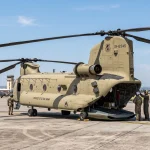
- High-Altitude Recovery of Downed Military Aircraft: In 2002, a civilian Mi-26 slung and recovered a downed US Army MH-47E Chinook helicopter from an 8,500-foot mountain peak in Afghanistan, carrying the 24,000-pound airframe over 100 miles back to Bagram Air Base.
- Giant Mammoths and Infrastructure Construction: In 1999, an Mi-26 air-lifted a 23-ton block of frozen permafrost containing a fully preserved woolly mammoth carcass from the Siberian tundra to an ice laboratory in Khatanga.
Frequently Asked Questions About the Worlds Largest Helicopter
What is the worlds largest helicopter ever constructed?
The largest helicopter ever built was the Soviet Mil V-12 Homer (1968), with a maximum takeoff weight of 105,000 kg (231,485 lbs) and a transverse rotor wingspan of 67 meters.
What is the worlds largest helicopter currently flying?
The Mil Mi-26 Halo is the largest operational helicopter in the world today. It weighs up to 56,000 kg at takeoff and lifts 20,000 kg of cargo internally or via external sling hook.
Can Western helicopters match the size of the Mi-26?
While Western helicopters like the Sikorsky CH-53K King Stallion feature advanced digital fly-by-wire flight controls and high power density (lifting 35,000 lbs externally), the Mi-26 remains significantly larger in gross weight (123,458 lbs vs 88,000 lbs) and internal cargo hold volume.
How do giant helicopters compare to scenic passenger helicopters?
Super-heavy helicopters are high-torque industrial airlifters designed for austere logistics. Scenic coastal passenger flights use agile, quiet light turbine helicopters engineered for 180-degree panoramic passenger views. Discover more in our guide to biggest helicopter on Earth dimensions and size records.
Get our latest guides, news, and insights highlighted in your Google Search & AI Overviews.