✨ This article was AI edited. Editorial responsibility: HelicopterToursofSantaBarbara.com.
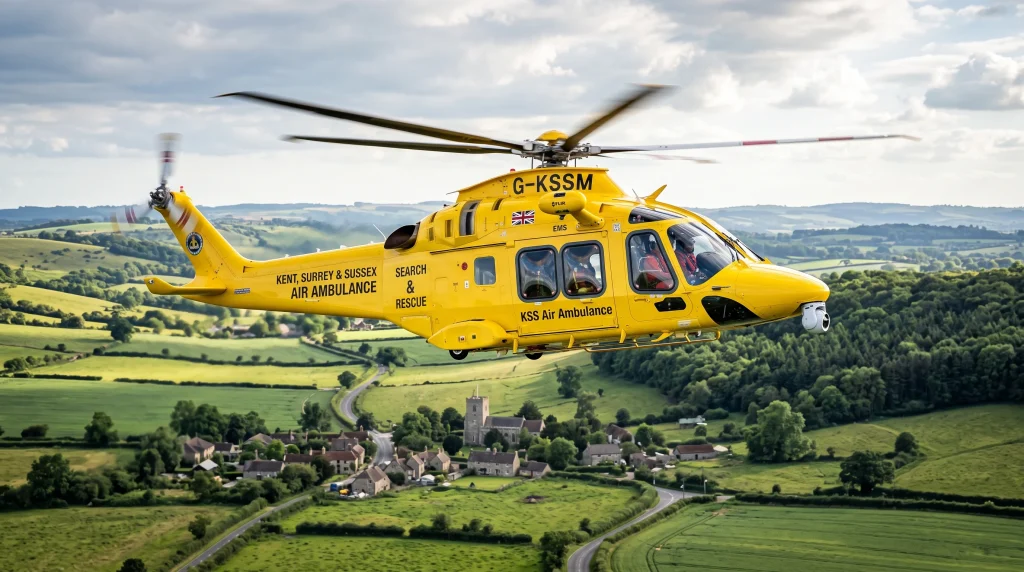
What does a yellow helicopter mean in the UK? In United Kingdom airspace, a bright yellow helicopter signifies a dedicated civil or state emergency aircraft—most commonly an Air Ambulance delivering pre-hospital emergency trauma medicine, an active Search and Rescue (SAR) mission, or high-consequence utility infrastructure inspection (such as National Grid powerline surveillance).
The high-visibility yellow livery (historically British Standard BS 381C Golden Yellow) is mandated for maximum visual conspicuity against overcast maritime skies, undulating terrain, and ground hazards during low-altitude emergency hovering.
The Operational Identity of Yellow Helicopters in British Airspace
Seeing a low-flying yellow helicopter circling over a neighborhood, highway, or open countryside frequently prompts immediate public curiosity. Unlike general aviation civil rotorcraft that feature custom corporate schemes, bright yellow paintwork in the UK is deliberately selected by aviation safety regulators and emergency dispatch organizations to maximize visual contrast under the UK’s notoriously gray, overcast maritime weather.
Historically, the color yellow became synonymous with British aerial rescue through the Royal Air Force (RAF) Search and Rescue Force, whose Sea King HAR3 helicopters maintained round-the-clock standby across coastal and mountainous stations for over 35 years. In modern civil operations, yellow remains the primary high-visibility base for three critical sectors:
- Air Ambulance & Pre-Hospital Trauma Services: Several regional NHS-partnered air ambulance charities operate fleets with prominent yellow and high-vis red accents (such as Midlands Air Ambulance, East Anglian Air Ambulance, and Devon Air Ambulance).
- Coastguard & Offshore SAR: HM Coastguard search and rescue aircraft, operated under commercial contract by Bristow Helicopters, fly Leonardo AW189 and Sikorsky S-92 airframes adorned in red, white, and high-visibility yellow markings.
- Critical Infrastructure & Grid Surveillance: National Grid Electricity Distribution and Network Rail utilize yellow turbine helicopters (principally Airbus H135 and Bell 206 JetRangers) for low-level thermographic line inspections and railway corridor clearing.
Why Are Emergency Helicopters Painted Yellow? The Science of Conspicuity
The selection of yellow is grounded in human visual perception and optical physics. The human eye’s retinal cone photoreceptors are most sensitive to wavelengths near 555 nanometers (the yellow-green band of the visible spectrum) under photopic daylight conditions. During twilight, heavy precipitation, or sea mist, yellow provides the highest contrast against:
- Dark Ground Clutter: Urban infrastructure, dense pine forests, and asphalt roadways appear dark from the air; a yellow airframe stands out sharply to other low-flying aircraft.
- Choppy Coastal Waters: Gray ocean waves and whitecaps quickly camouflage blue, black, or metallic aircraft; yellow remains visible at distances exceeding five nautical miles.
- Transmission Tower Cables: Utility pilots operating within 50 feet of high-voltage transmission lines require ground crews and third-party aviators to immediately identify their presence in restricted utility corridors.
Major Operators of Yellow Helicopters Across the United Kingdom
| Operator / Entity | Airframe Types | Primary Mission Profile | Livery Configuration |
|---|---|---|---|
| Midlands Air Ambulance | Airbus H145 / H135 | Pre-hospital emergency medicine (HEMS) | Full canary yellow with red and green reflective chevrons |
| East Anglian Air Ambulance (EAAA) | Airbus H145 | Trauma resuscitation and inter-hospital patient transfer | Yellow forward fuselage with red empennage |
| National Grid Electricity Distribution | Airbus H135 / Bell 206L | High-voltage line patrol, LiDAR scanning, thermal imaging | Solid bright yellow with blue company branding |
| Historical RAF SAR Force (Retired) | Westland Sea King HAR3 | Mountain & maritime rescue (transitioned to Bristow/Coastguard) | Iconic overall gloss rescue yellow |
| Devon Air Ambulance Trust | Airbus H145 | Emergency trauma and rural medical rescue | Daylight yellow with deep blue and red markings |
Why Is a Yellow Helicopter Hovering or Circling Near You?
When a yellow helicopter lingers over a residential area or highway, it is almost invariably executing one of three standardized tactical maneuvers governed by UK Civil Aviation Authority (CAA) exemptions:
- Air Ambulance Landing Site Reconnaissance: Emergency doctors and paramedics need a secure landing site (confined area) within 200–400 yards of the patient. Pilots will circle twice to assess wind direction, overhead wire hazards, trees, and domestic livestock before descending into school fields, parks, or closed roadways.
- Infrastructure Thermal Line Scanning: Utility helicopters fly low and slow along power line corridors at 30 to 50 knots. High-definition infrared cameras inspect insulator strings and pylon joints for overheating components that could cause regional grid blackouts.
- Police Mutual Aid or Missing Person Search: While the National Police Air Service (NPAS) predominantly operates blue and yellow Airbus H135 and Vulcanair P68 fixed-wing aircraft, SAR helicopters frequently assist local constabularies in sweeping rivers, moors, and coastlines with thermal imaging sensors.
How to Track Yellow Helicopters in Real Time
Modern UK emergency aircraft broadcast Mode-S and ADS-B Out signals that can be tracked on public radar software such as Flightradar24, RadarBox, and ADS-B Exchange. To identify an active flight:
- Look for Distinctive Call Signs: Air ambulances typically use call signs like “Helimed” (e.g., Helimed 03, Helimed 06) followed by their regional station code.
- Check Coastguard Identifiers: SAR Coastguard flights routinely use “Rescue” call signs (e.g., Rescue 912, Rescue 936).
- Examine Utility Flight Paths: National Grid aircraft typically fly back-and-forth grid-shaped “lawnmower” patterns across rural easements rather than straight point-to-point legs.
For more detailed technical insights on flight safety regulations and rotorcraft capabilities, explore our guides to Helicopter Flying Operations, examine commercial Helicopter Types, or review the historical safety dynamics in our Helicopter Safety & Crash Investigations hub.
Get our latest guides, news, and insights highlighted in your Google Search & AI Overviews.