✨ This article was AI edited. Editorial responsibility: HelicopterToursofSantaBarbara.com.
Produced with AI. This article was artificially generated. Editorial responsibility: HelicopterToursofSantaBarbara.com.
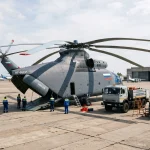
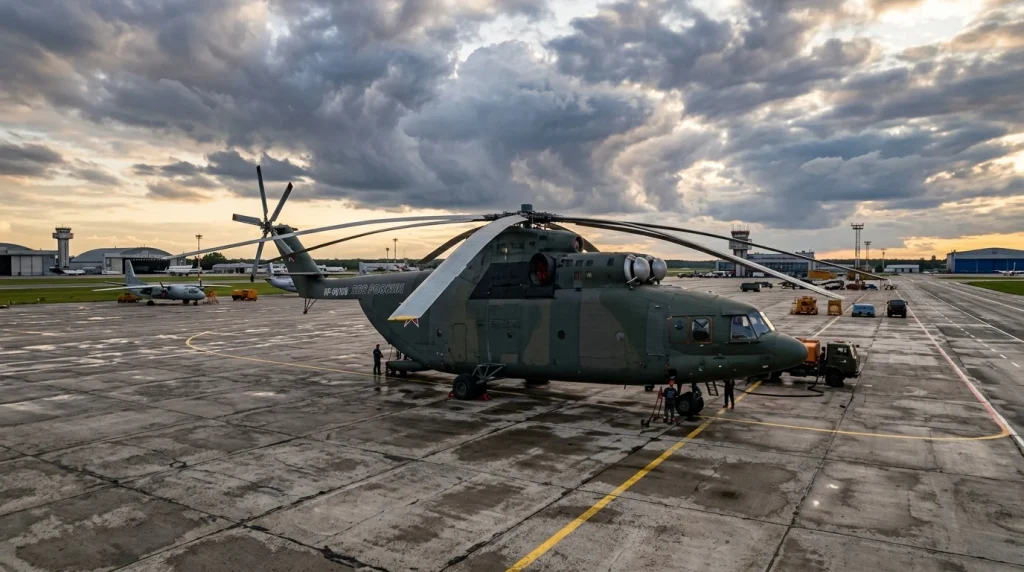
The Mil Mi-26 (NATO reporting name “Halo”) is the biggest operational helicopter in the world, boasting a maximum takeoff weight of 56,000 kg (123,450 lbs) and an 8-blade main rotor spanning 32 meters. Historically, the experimental Mil V-12 remains the largest helicopter ever built, though it never reached series production.
The Physics and Engineering of Heavy-Lift Rotary Flight
Designing a super-heavyweight helicopter represents one of the most formidable aerodynamic challenges in mechanical engineering. Unlike fixed-wing cargo aircraft that rely on forward speed over static wings to generate thousands of pounds of lift, a rotary aircraft must derive all upward lift, directional control, and forward velocity from a spinning rotor disk. As rotary airframes scale into tens of thousands of pounds, engineers encounter severe aerodynamic penalties, including retreating blade stall, extreme root bending moments, immense transmission torque loads, and dangerous ground resonance dynamics.
To overcome these physical constraints, aviation powerhouses in both the East and West pushed rotary architecture to its structural limits, creating behemoths capable of airlifting main battle tanks, recovery flights of downed airliners, and deploying entire infantry battalions to remote mountain peaks.
Mil Mi-26 “Halo”: The Undisputed Heavyweight Champion
First flying in December 1977 and entering commercial and military service in the early 1980s, the Soviet-engineered Mil Mi-26 remains the largest, heaviest, and most powerful production helicopter in human history. Designed to transport military hardware and heavy commercial oil exploration equipment into Siberian wilderness terrains without paved runways, the Mi-26 redefined heavy-lift capabilities.
Core Specifications of the Mil Mi-26:
- Maximum Takeoff Weight (MTOW): 56,000 kg (123,450 lbs / 56 metric tons).
- Maximum Internal Payload: 20,000 kg (44,090 lbs)—equivalent to an empty Lockheed C-130 Hercules transport aircraft!
- External Sling Capacity: Up to 20 metric tons of cargo.
- Powerplant: Two Lotarev D-136 turboshaft engines producing an astronomical 11,400 shaft horsepower (shp) each (22,800 shp total).
- Main Rotor Diameter: 32.0 meters (105 feet), featuring 8 composite titanium-spar blades.
- Cargo Cabin Dimensions: 12.0 meters long, 3.2 meters wide, and 3.1 meters high—spacious enough to accommodate two armored personnel carriers or 90 fully equipped combat troops.
One of the Mi-26’s most historic operational moments occurred in 2002 in Afghanistan, when a civilian-registered Mi-26 was contracted by the U.S. military to sling-load and recover a downed U.S. Army MH-47E Chinook helicopter from a high-altitude mountain ridge—a rescue feat that no Western helicopter possessed the lifting margin to achieve.
Mil V-12 (Homer): The Largest Helicopter Ever Flown
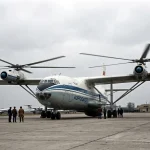
While the Mi-26 holds the operational crown, the experimental Mil V-12 (designated “Homer” by NATO) holds the all-time absolute record as the largest rotary-wing aircraft ever constructed. Developed in the late 1960s to transport intercontinental ballistic missiles (ICBMs) to remote, roadless launch silos, the V-12 abandoned conventional single-rotor layouts in favor of a massive transverse twin-rotor configuration.
Supported on inverted giant wing structures extending laterally from the fuselage, the V-12 utilized two complete Mi-6 rotor heads and transmission assemblies:
- Gross Takeoff Weight: An astonishing 105,000 kg (231,485 lbs / 105 metric tons).
- Engines: Four Soloviev D-25VF turboshaft engines producing 26,000 total horsepower.
- World Record Lift: On August 6, 1969, the V-12 lifted a payload of 44,205 kg (97,455 lbs) to an altitude of 2,255 meters (7,400 feet)—a FAI absolute world record that stands unbeaten to this day.
Only two prototypes were built before Soviet satellite reconnaissance and rail-mobile ICBM systems rendered the expensive mega-helicopter obsolete, relegating the surviving airframe to the Monino Air Force Museum near Moscow.
Western Heavyweights: CH-53K King Stallion & CH-47F Chinook
Western aerospace design diverged significantly from Russian multi-ton mega-transports, emphasizing naval vessel deck compatibility, rapid tactical battlefield mobility, and high hot-and-high density altitude performance.
1. Sikorsky CH-53K King Stallion
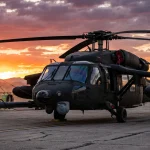
The CH-53K King Stallion represents the state-of-the-art in Western heavy-lift rotary technology. Designed exclusively for the U.S. Marine Corps, the King Stallion features three General Electric T408 turboshaft engines generating 7,500 shp each (22,500 total shp) and advanced fourth-generation fly-by-wire flight control systems:
- Maximum Gross Weight: 39,916 kg (88,000 lbs).
- External Lift Capacity: 12,250 kg (27,000 lbs) over an operating radius of 110 nautical miles under scorching ambient temperatures.
- Shipboard Compatibility: Equipped with automatic blade-fold and tail-pylon stowage mechanisms allowing full operational integration aboard Navy amphibious assault ships (LHD/LHA).
2. Boeing CH-47F Chinook & Columbia 234
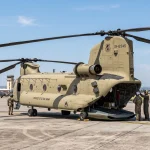
The iconic tandem-rotor Chinook, distinguished by its twin contra-rotating three-blade rotors, eliminates the power-sapping tail rotor entirely. By channeling 100% of engine power into vertical lift, the Chinook achieves unmatched high-altitude utility:
- Maximum Takeoff Weight: 22,680 kg (50,000 lbs).
- External Cargo Hook Limit: 11,800 kg (26,000 lbs on triple cargo hooks).
- Agility & Speed: With a maximum cruise speed exceeding 160 knots (184 mph), the Chinook is remarkably one of the fastest operational helicopters in service.
Global Heavy-Lift Rotary Comparison Matrix
| Aircraft Model | Country of Origin | Max Takeoff Weight (MTOW) | Max Payload Capacity | Total Engine Horsepower | Rotor Diameter |
|---|---|---|---|---|---|
| Mil V-12 (Prototype) | Soviet Union | 105,000 kg (231,485 lbs) | 44,205 kg (97,455 lbs) | 26,000 shp (4 engines) | 35.0 m × 2 |
| Mil Mi-26 “Halo” | Russia / USSR | 56,000 kg (123,450 lbs) | 20,000 kg (44,090 lbs) | 22,800 shp (2 engines) | 32.0 m (8 blades) |
| Sikorsky CH-53K King Stallion | United States | 39,916 kg (88,000 lbs) | 16,330 kg (36,000 lbs) | 22,500 shp (3 engines) | 24.1 m (7 blades) |
| Sikorsky CH-53E Super Stallion | United States | 33,340 kg (73,500 lbs) | 14,515 kg (32,000 lbs) | 13,140 shp (3 engines) | 24.1 m (7 blades) |
| Boeing CH-47F Chinook | United States | 22,680 kg (50,000 lbs) | 10,886 kg (24,000 lbs) | 9,466 shp (2 engines) | 18.3 m × 2 |
| Sikorsky S-64 Aircrane | United States | 21,320 kg (47,000 lbs) | 11,340 kg (25,000 lbs) | 9,000 shp (2 engines) | 21.9 m (6 blades) |
Specialized Skycranes: The Sikorsky S-64 Aircrane / CH-54 Tarhe
Unlike standard cargo helicopters with enclosed fuselages, purpose-built “skycranes” strip away the passenger cabin entirely, leaving a skeletal airframe with an aft-facing pilot control station. The Erickson S-64 Air-Crane utilizes this design to maximize external payload fraction for precision civil engineering, high-voltage power transmission tower erection, and aerial firefighting (carrying up to 2,650 gallons of water in an internal tank drop system).
Frequently Asked Questions
What is the biggest helicopter currently in active service?
The Mil Mi-26 “Halo” is the largest operational helicopter flying today. With a maximum takeoff weight of 56 metric tons (123,450 lbs) and a payload capacity of 20,000 kg, it carries more than double the cargo of any Western production helicopter.
What was the largest helicopter ever built in history?
The experimental Soviet Mil V-12 (NATO: Homer) is the largest helicopter ever constructed. It had a maximum takeoff weight of 105 metric tons (231,485 lbs) and set the absolute rotary payload world record in 1969 by lifting 44,205 kg (over 97,000 lbs) to an altitude of 7,400 feet.
What is the most powerful American heavy-lift helicopter?
The Sikorsky CH-53K King Stallion is the most powerful Western helicopter. Built for the U.S. Marine Corps, it features three General Electric turboshafts delivering 22,500 total shaft horsepower, allowing it to lift 27,000 lbs externally over an extended combat radius.
Get our latest guides, news, and insights highlighted in your Google Search & AI Overviews.