✨ This article was AI edited. Editorial responsibility: HelicopterToursofSantaBarbara.com.
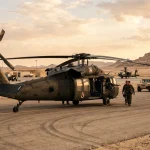
Blackhawk military helicopters represent the backbone of United States Army tactical combat mobility, special operations direct action, and allied military airlift. Operating under the United States military designation Sikorsky UH-60 (utility) and MH-60 (special operations), these twin-turbine combat rotorcraft excel across air assault troop insertion, medical evacuation (MEDEVAC), armed reconnaissance, electronic warfare, and covert hostage rescue missions. Specialized variants flown by the elite 160th Special Operations Aviation Regiment (SOAR)—known as the Night Stalkers—integrate terrain-following radar, aerial refueling probes, and precision-guided Hellfire munitions.
Since entering service during the late Cold War era, the Black Hawk has participated in every major armed conflict involving United States ground forces. Unlike commercial transport rotorcraft, military Black Hawks are engineered around extreme ballistic survivability, electro-optical battlefield sensors, and advanced defensive electronic countermeasure suites. Understanding the modern military capabilities of the Black Hawk requires exploring its specialized special-ops variants, weapons configurations, and the ongoing modernization initiatives that will keep the platform flying into the 2030s and beyond.
Blackhawk Military Variants: Specialized Combat Roles
The Department of Defense utilizes distinct Black Hawk variants tailored for specific battlefield commands and specialized combat missions.
| Military Variant | Operating Unit / Branch | Specialized Mission Role | Key Combat Equipment |
|---|---|---|---|
| UH-60M Black Hawk | US Army Regular Divisions | Tactical Air Assault & Troop Mobility | Digital Glass Cockpit, T700-GE-701D Engines, Wide-Chord Blades |
| HH-60M MEDEVAC | US Army Aeromedical Units | Combat Search and Medical Evacuation | Internal Oxygen Generation, Litter Lifts, Patient Monitoring |
| MH-60M Direct Action Penetrator (DAP) | 160th SOAR (Night Stalkers) | Armed Gunship & Escort Attack | 30mm M230 Chain Gun, AGM-114 Hellfire, 2.75-in Hydra Rockets |
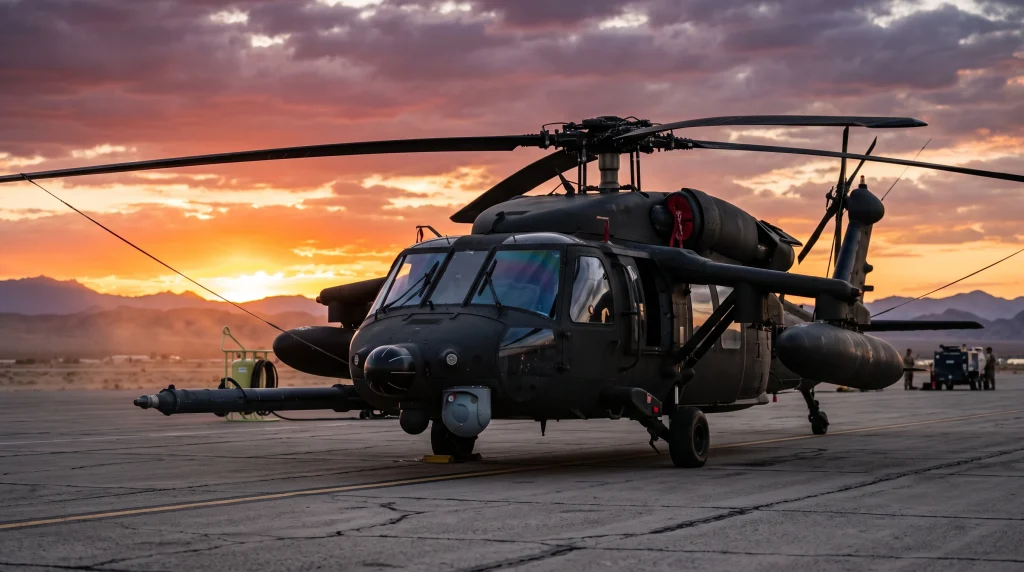
| MH-60M Combat Assault | 160th SOAR (Night Stalkers) | Deep Covert Insertion / Infiltration | In-Flight Refueling Probe, Raytheon AN/APQ-187 Radar, FLIR |
| HH-60W Jolly Green II | US Air Force Rescue Squadrons | Combat Search and Rescue (CSAR) | Extended Internal Fuel Tanks, Radar Warning Receivers, Hoists |
| Low-Observable “Stealth” Black Hawk | Joint Special Operations Command (JSOC) | High-Threat Covert Infiltration | Radar-Absorbent Skin, Noise-Damping Tail Fairing, Angled Nacelles |
The 160th SOAR (Night Stalkers) and the MH-60M
The apex of military rotary-wing performance is found in the MH-60M, operated exclusively by the US Army’s 160th Special Operations Aviation Regiment (Airborne). These aircraft are engineered to insert Special Forces A-teams, Navy SEALs, and Army Rangers deep behind enemy lines under complete darkness and zero-illumination weather conditions.
Powerplant & High-Altitude Performance
Standard Black Hawks are powered by General Electric T700 engines. However, the special-ops MH-60M features dual General Electric YT706 turboshaft engines producing 2,600 shaft horsepower each—an increase of nearly 30% over standard Army models. This extra power enables the Night Stalkers to hover out of ground effect at extreme altitudes exceeding 10,000 feet in mountainous operational theaters like the Hindu Kush.
Avionics: The Common Avionics Architecture System (CAAS)
The MH-60M cockpit integrates Rockwell Collins’ CAAS glass display suite, combining forward-looking infrared (FLIR) night sensors, multimode terrain-following/terrain-avoidance (TF/TA) radar, and digital moving maps. Pilots can fly low-level contour flight (“nap of the earth”) just 50 feet above trees and power lines in total zero-visibility dust or fog.
Defensive Electronic Countermeasures & Weapons Integration
In modern anti-access/area-denial (A2/AD) combat environments, military Black Hawks are equipped with automated survivability suites to defeat surface-to-air missiles:
- AN/AAR-57 Common Missile Warning System (CMWS): Optical and ultraviolet sensors detect the rocket plume of incoming shoulder-fired surface-to-air missiles (MANPADS), automatically cueing countermeasures without pilot input.
- AN/ALE-47 Countermeasure Dispenser: Ejects precision flares to decoy heat-seeking infrared missiles and chaff cartridges to blind radar-guided munitions.
- AN/ALQ-144 / AN/ALQ-212 Infrared Jammers: Modulated omnidirectional thermal transmitters that disrupt the optical tracking reticles of incoming missiles.
- Weapons Suites: In addition to crew-served M240H 7.62mm machine guns or M134 7.62mm six-barrel miniguns mounted in the cabin windows, the Direct Action Penetrator (DAP) configuration mounts external stub wings carrying up to 16 laser-guided Hellfire missiles or dual 30mm automatic cannon pods.
Frequently Asked Questions About Military Blackhawk Helicopters
What is the difference between a UH-60 and an MH-60?
The UH-60 is the standard utility tactical transport helicopter used by regular US Army units. The MH-60 is a heavily modified special operations variant flown by the 160th SOAR, equipped with aerial refueling probes, uprated YT706 engines, terrain-following radar, and specialized weapons pylons.
Can a Blackhawk helicopter refuel in the air?
Special operations variants (MH-60M) and combat rescue models (HH-60G/W) feature a telescoping in-flight refueling probe mounted on the starboard nose, allowing them to take on aviation fuel mid-flight from Lockheed HC-130 or MC-130 tankers for unlimited operational range.
What weapons can a military Black Hawk carry?
Standard transport variants carry two door-mounted 7.62mm M240H machine guns or M134 miniguns. The armed gunship variant (MH-60M DAP) carries 30mm chain guns, 70mm Hydra rocket pods, and AGM-114 Hellfire anti-armor missiles.
How do military helicopters differ from civilian tour helicopters?
Military helicopters are engineered with heavy ballistic armor, redundant self-sealing fuel cells, and radar jamming systems for combat assault missions. In contrast, civilian tour aircraft emphasize acoustic dampening, wide panoramic sightseeing windows, and smooth passenger ergonomics. Learn more in our overview of UH-60 Black Hawk technical specifications and combat history.
Get our latest guides, news, and insights highlighted in your Google Search & AI Overviews.