✨ This article was AI edited. Editorial responsibility: HelicopterToursofSantaBarbara.com.
Produced with AI. This article was artificially generated. Editorial responsibility: HelicopterToursofSantaBarbara.com.
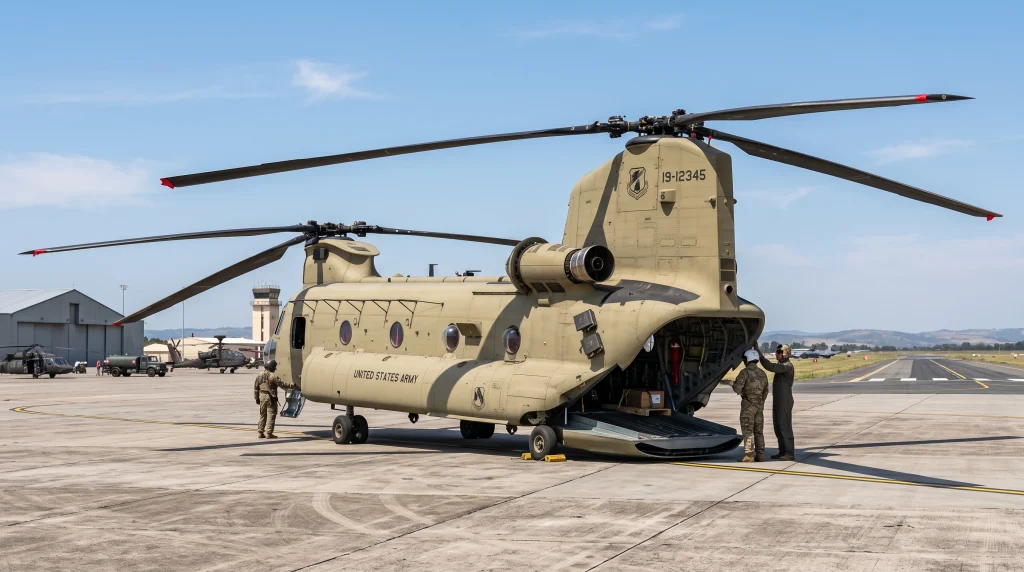
The “big military helicopter with two propellers” is almost always the Boeing CH-47 Chinook, a heavy-lift tactical transport rotorcraft distinctive for its tandem-rotor configuration featuring two large counter-rotating three-bladed rotor systems mounted at the front and rear of the fuselage. In aviation terminology, these rotating lifting surfaces are rotors rather than propellers; by spinning in opposite directions, the tandem rotors cancel each other’s torque, eliminating the need for a tail rotor and dedicating 100% of engine power toward vertical lift.
Every year, millions of people observe large twin-rotor military aircraft transiting low-altitude airspace during tactical maneuvers, disaster relief operations, or VIP transport missions. The unfamiliarity of rotary-wing aerodynamics often leads observers to describe these iconic machines as having “two propellers” or “twin fans.” Examining the engineering mechanics of the Boeing CH-47 Chinook—alongside other twin-rotor military platforms like the Bell-Boeing V-22 Osprey tiltrotor and the Kamov Ka-52 coaxial attack helicopter—demystifies why twin-rotor architectures are chosen for extreme tactical airlift missions.
Tandem Rotors vs Conventional Helicopters: Aerodynamic Physics
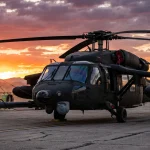
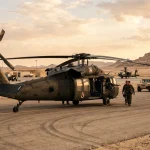
Conventional helicopters (such as the UH-60 Black Hawk or Bell 206) utilize a single main rotor to generate lift and forward thrust. Because Newton’s third law dictates that spinning a rotor creates an equal and opposite torque reaction on the fuselage, conventional helicopters require a vertical tail rotor to blow air sideways and prevent the cabin from spinning uncontrollably. This tail rotor consumes between 10% and 15% of the helicopter’s total engine horsepower purely to counteract torque without producing any vertical lift.
| Design Feature | Boeing CH-47 Chinook (Tandem Rotor) | Conventional Helicopter (e.g. Black Hawk) | Bell-Boeing V-22 Osprey (Tiltrotor) |
|---|---|---|---|
| Rotor Configuration | Two Counter-Rotating Rotors (Tandem) | Single Main Rotor + Tail Rotor | Twin Wingtip Proprotors (Tiltrotor) |
| Anti-Torque Method | Aerodynamic Torque Cancellation | Anti-Torque Tail Rotor | Counter-Rotating Proprotors |
| Lift Efficiency | 100% Engine Power to Vertical Lift | 85-90% to Lift (10-15% to Tail Rotor) | Converts to Wing-Borne Flight in Cruise |
| Center of Gravity Range | Extremely Wide (Fore/Aft Trim Flexibility) | Narrow (Sensitive to Weight Distribution) | Moderate (Constrained by Wing Geometry) |
| Maximum Speed ($V_{ne}$) | 170 knots (196 mph / 315 km/h) | 159 knots (183 mph / 294 km/h) | 275 knots (316 mph / 509 km/h) |
Engineering the Boeing CH-47 Chinook: Why It Has Two Rotors
Developed originally by Vertol (acquired by Boeing in 1960), the Chinook first flew in 1961 and remains in active production today in its CH-47F Block II iteration. Several mechanical engineering breakthroughs make its tandem system exceptionally effective:
1. Intermeshing Synchronizing Drive Shaft
A common question from observers watching a Chinook fly is why the front and rear rotor blades do not collide as they spin, since the rotor discs overlap horizontally. The two rotors are physically linked by a continuous drive shaft running along the top of the fuselage cabin through synchronizing gearboxes. The forward and aft rotor hubs are mechanically timed 60 degrees out of phase, ensuring that as a forward blade passes through the overlap zone, the aft blade sweeps through the gap without physical contact even under extreme cyclic maneuvering loads.
2. Differential Pitch Control
To pitch the nose down for forward flight, a tandem helicopter increases collective blade pitch on the rear rotor while decreasing pitch on the forward rotor. To roll left or right, both rotors tilt their cyclic swashplates in tandem. For yaw heading control, the rotors tilt in opposite lateral directions, creating an immense turning couple without needing tail-rotor pedals.
3. Pinnacle Landings and Amphibious Capabilities
Because the aft rotor is mounted on a raised rear pylon above the cabin roofline, the Chinook can perform “pinnacle landings” on mountain ledges or building rooftops. The pilot holds the front rotor airborne while touching the rear wheels and lowering the aft cargo ramp directly onto the terrain, allowing troops or vehicles to disembark safely. Furthermore, the sealed lower fuselage allows the Chinook to make emergency water touchdowns and deploy Special Forces combat rubber raiding craft (Zodiac boats) directly from the flooded ramp.
Other Military Aircraft Observers Confuse with the Chinook
While the CH-47 Chinook is the definitive “helicopter with two propellers,” other modern twin-rotor military aircraft frequently produce similar visual impressions:
- Bell-Boeing V-22 Osprey: A tiltrotor aircraft featuring twin three-bladed proprotors mounted on pivoting wingtip nacelles. The Osprey takes off vertically like a helicopter, then rotates its nacelles forward 90 degrees in flight to cruise like a high-speed turboprop airplane at 275 knots.
- Kamov Ka-52 Alligator: A Russian attack helicopter featuring two counter-rotating main rotors mounted on a single mast (coaxial rotor system), eliminating the tail rotor and creating a compact, highly agile combat platform.
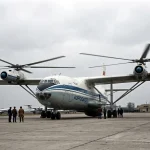
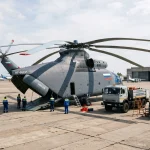
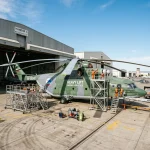
- Mil V-12 Homer: The largest experimental helicopter in history, which featured two giant rotors mounted side-by-side on transverse wings spanning 67 meters.
Frequently Asked Questions About Helicopters with Two Propellers
What is the military helicopter with two large blades called?
The iconic military helicopter with two large rotor systems mounted on top of the fuselage is the Boeing CH-47 Chinook. It is a heavy-lift tactical transport aircraft widely used by the US Army and international forces.
Are the blades on a Chinook propellers or rotors?
They are rotary-wing lifting surfaces known as rotors, not propellers. Unlike airplane propellers which only provide horizontal pull/thrust, helicopter rotors provide both vertical aerodynamic lift to keep the aircraft airborne and cyclic control for multi-directional flight.
Why does the Chinook helicopter not have a tail rotor?
The Chinook has two counter-rotating main rotors that spin in opposite directions (the front rotor spins counter-clockwise, and the rear rotor spins clockwise). Because the torque reactions generated by each rotor cancel each other out, no anti-torque tail rotor is needed.
How do commercial tour helicopters differ from the Chinook?
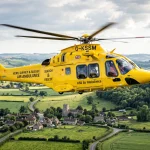
Commercial scenic tour operators use streamlined single-rotor turbine aircraft (like the Airbus H130 or Bell 206) engineered for quiet community acoustic signatures and passenger comfort rather than heavy battlefield cargo. Discover rotorcraft designs in our guide on world record transport helicopters.
Get our latest guides, news, and insights highlighted in your Google Search & AI Overviews.