✨ This article was AI edited. Editorial responsibility: HelicopterToursofSantaBarbara.com.
Produced with AI. This article was artificially generated. Editorial responsibility: HelicopterToursofSantaBarbara.com.
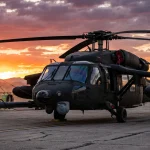
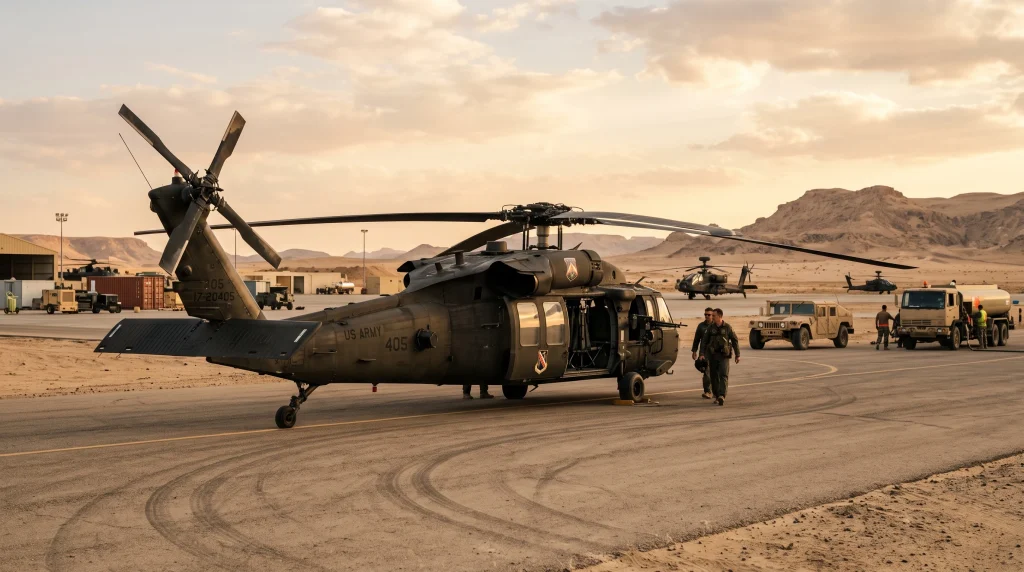
Blackhawk helicopters—formally designated the Sikorsky UH-60 Black Hawk—are twin-engine, four-bladed, medium-lift tactical utility rotorcraft manufactured by Sikorsky Aircraft (a Lockheed Martin company) for the United States Armed Forces and over 35 international allied nations. Powered by dual General Electric T700 turboshafts delivering up to 4,000 combined shaft horsepower to an elastomeric titanium-core main rotor head, the Black Hawk carries an 11-person combat infantry squad or an external sling load of 9,000 lbs (4,082 kg) at cruise speeds exceeding 150 knots (278 km/h).
Introduced to active service in 1979 to replace the legendary Bell UH-1 Iroquois (Huey), the Sikorsky UH-60 Black Hawk has evolved into the most battle-tested tactical transport helicopter in military history. Engineered from its inception around crew combat survivability, redundant flight controls, and high ballistic damage tolerance, the airframe serves as the foundation for specialized combat search and rescue (HH-60G/W Pave Hawk), special operations covert insertion (MH-60M), maritime anti-submarine warfare (MH-60R Seahawk), and presidential tactical airlift missions.
Sikorsky UH-60 Black Hawk Variants & Technical Specifications
Over four decades of continuous production, the Black Hawk platform underwent major avionics overhauls, engine uprates, and composite rotor blade retrofits.
| Variant Designation | Powerplant Architecture | Max Takeoff Weight (MTOW) | External Hook Capacity | Avionics Suite / Flight Control | Primary Combat Role |
|---|---|---|---|---|---|
| UH-60A Black Hawk (1979) | 2x GE T700-GE-700 (1,560 shp ea) | 20,250 lbs (9,185 kg) | 8,000 lbs (3,628 kg) | Analog Instruments, Mechanical Linkages | Baseline Tactical Air Assault |
| UH-60L Black Hawk (1989) | 2x GE T700-GE-701C (1,890 shp ea) | 22,000 lbs (9,979 kg) | 9,000 lbs (4,082 kg) | Enhanced Transmission, Upgraded AFCS | Medium Tactical Troop Transport |
| UH-60M Black Hawk (2006) | 2x GE T700-GE-701D (2,000 shp ea) | 22,000 lbs (9,979 kg) | 9,000 lbs (4,082 kg) | Four-Display Glass Cockpit, Dual Digital AFCS | Digital Modernized Air Assault |
| MH-60M Special Ops (160th SOAR) | 2x YT706-GE-700 (2,600 shp ea) | 24,500 lbs (11,113 kg) | 9,000 lbs (4,082 kg) | Terrain-Following Radar, FLIR, Air Refueling | Covert Night Tactical Infiltration |
| MH-60R Seahawk (US Navy) | 2x GE T700-GE-401C (1,900 shp ea) | 23,500 lbs (10,659 kg) | 6,000 lbs (2,722 kg) | Multimode Radar, Sonar, ESM, Link 16 | Anti-Submarine & Surface Warfare |
| S-70i Black Hawk (International) | 2x GE T700-GE-701D (2,000 shp ea) | 22,000 lbs (9,979 kg) | 9,000 lbs (4,082 kg) | Integrated Dual Flight Management System | Export Military & Civil Defense |
Ballistic Survivability & Crashworthy Engineering
The core philosophy governing the design of Blackhawk helicopters was structural resilience against intense ground fire during low-altitude air assault missions. Lessons learned from Vietnam dictated that every critical subsystem must tolerate direct hits from 7.62mm and 23mm armor-piercing rounds.
1. Progressive Energy-Absorbing Landing Gear
The Black Hawk utilizes fixed, heavy-duty main landing gear oleo struts designed to absorb vertical crash impacts up to 38 feet per second (11.5 m/s). In catastrophic hard landings, the landing gear collapses telescopically, dissipating immense kinetic energy before force reaches the cabin floor.
2. Armored Crew Cockpit and Energy-Attenuating Seating
The pilot and co-pilot seats are lined with boron carbide ceramic armor panels capable of defeating 23mm projectile fragments. The seats sit on stroking attenuation mechanisms that yield vertically, keeping deceleration loads on the pilots’ spinal columns within survivable human thresholds.
3. Self-Sealing Fuel Tanks and Ballistic Rotor Blades
Internal fuel bladders are constructed from multi-layer Kevlar and vulcanized synthetic rubber. When pierced by enemy fire, the chemical reaction of the escaping fuel expands the inner sealant, closing holes up to 23mm instantly without explosion or catastrophic fuel drainage. The main rotor blades incorporate titanium spars wrapped in fiberglass composites, capable of sustaining direct hits from 23mm cannon fire and continuing controlled flight for over 30 minutes.
Combat Operations History: Grenada to Modern Battlefields
The UH-60 has deployed across every major United States military engagement since 1983:
- Operation Urgent Fury (Grenada, 1983): The Black Hawk’s combat baptism, where airframes sustained heavy anti-aircraft ground fire yet returned crews safely back to naval vessels.
- Operation Desert Storm (1991): Over 400 Black Hawks conducted the largest helicopter air assault in military history, inserting thousands of troops deep behind Iraqi lines in the Euphrates River valley.
- Battle of Mogadishu (1993): The intense urban combat immortalized in Black Hawk Down demonstrated the helicopter’s structural toughness when Super 61 and Super 64 were brought down by direct RPG-7 rocket hits, with surviving crew members protected by the crash-attenuating airframe design.
- Operation Neptune Spear (Abbottabad, 2011): Specially modified low-observable (“Stealth Black Hawk”) rotorcraft featuring radar-absorbent skin, angled engine nacelles, and sound-dampening rotor fairings carried US Navy SEALs to eliminate Osama bin Laden.
Civilian & Firefighting Evolution: The S-70 Firehawk
Beyond military combat, retired and specialized new-production UH-60 airframes serve as premier wildland aerial firefighting platforms. Designated the S-70 Firehawk, these machines are equipped with a 1,000-gallon (3,785-liter) retractable belly tank, a 60-second hover snorkel, and extended landing gear. Operated by CAL FIRE and the Los Angeles County Fire Department, the Firehawk drops precision water and retardant loads on steep mountain canyon fires across Southern California.
Frequently Asked Questions About Blackhawk Helicopters
How much does a UH-60 Blackhawk helicopter cost?
A new Sikorsky UH-60M Black Hawk costs approximately $21 million to $25 million depending on avionics, defensive electronic warfare suites, and weapons packages. Demilitarized surplus UH-60A models sold for civil firefighting and utility conversion range between $3 million and $7 million.
How fast can a Blackhawk helicopter fly?
The maximum cruise speed of a UH-60M Black Hawk is 151 knots (174 mph / 280 km/h), with a never-exceed speed ($V_{ne}$) of 193 knots (222 mph / 357 km/h) under standard atmospheric conditions.
How many troops can fit inside a Black Hawk?
The cabin accommodates a flight crew of four (pilot, co-pilot, and two crew chiefs/door gunners) plus 11 fully equipped combat troops with ruck gear. In maximum density emergency evacuation configurations, the cabin can transport up to 20 personnel or 6 medical litters.
How does the Black Hawk compare to civilian helicopters?
While the Black Hawk is engineered for high-g tactical survivability and heavy external sling loads, civilian executive helicopters prioritize acoustic comfort, panoramic sightseeing windows, and fuel economy. Explore the engineering differences in our guide to world record rotorcraft and transport helicopter classes.
Get our latest guides, news, and insights highlighted in your Google Search & AI Overviews.