✨ This article was AI edited. Editorial responsibility: HelicopterToursofSantaBarbara.com.
Produced with AI. This article was artificially generated. Editorial responsibility: HelicopterToursofSantaBarbara.com.
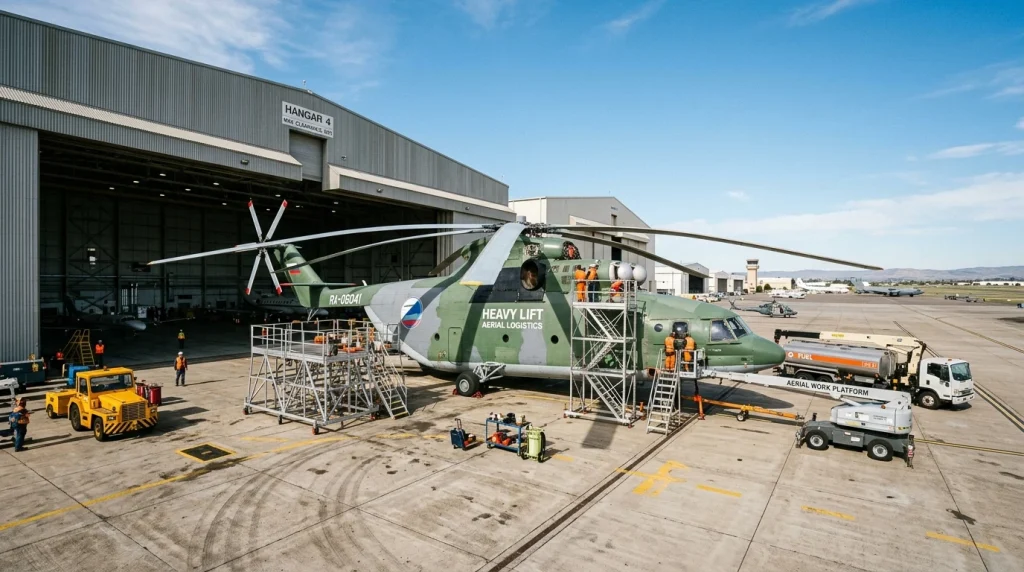
The title of the biggest helicopter on Earth depends on whether measuring active production rotorcraft or historical experimental giants. In serial production and daily service today, the Mil Mi-26 Halo is the largest helicopter on Earth, measuring 40.02 meters (131 ft 4 in) in overall length with rotors turning, standing 8.15 meters tall, and spinning an eight-bladed main rotor spanning 32 meters (105 ft). In historical aviation records, the Mil V-12 Homer remains the absolute largest rotary-wing aircraft ever constructed, with a wingspan of 67 meters (219 ft 10 in) across its twin transverse rotor systems and a maximum gross weight of 105,000 kg (231,485 lbs).
Quantifying the scale of mega-helicopters requires analyzing multiple dimensional axes: main rotor disc diameter, cargo bay cubic volume, overall tip-to-tail length, and maximum gross structural weight. Giant helicopters operate at the outer boundaries of aerodynamics, where rotor blade tips approach transonic speeds while the retreating blades risk aerodynamic stall. Evaluating the dimensional metrics of the largest machines ever built reveals the mechanical complexity required to achieve vertical flight at massive scales.
Dimensional Comparison: The Largest Helicopters on Earth
The following engineering data table compares the physical dimensions, rotor sweeps, and volumetric envelopes of the world’s most massive rotary-wing aircraft.
| Helicopter Airframe | Overall Length (Rotors Turning) | Height to Hub | Rotor Disc Diameter | Rotor Disc Area | Cargo Hold Volume |
|---|---|---|---|---|---|
| Mil V-12 Homer (Experimental) | 37.00 m (121 ft 5 in) | 12.50 m (41 ft 0 in) | 35.00 m (x2) (114 ft 10 in) | 1,924 m² (total swept) | 165.0 m³ (5,827 cu ft) |
| Mil Mi-26 Halo (Production) | 40.02 m (131 ft 4 in) | 8.15 m (26 ft 9 in) | 32.00 m (105 ft 0 in) | 804.2 m² (8,657 sq ft) | 121.0 m³ (4,273 cu ft) |
| Mil Mi-6 Hook | 41.74 m (136 ft 11 in) | 9.86 m (32 ft 4 in) | 35.00 m (114 ft 10 in) | 962.1 m² (10,356 sq ft) | 80.0 m³ (2,825 cu ft) |
| Sikorsky CH-53K King Stallion | 30.18 m (99 ft 0 in) | 8.66 m (28 ft 5 in) | 24.08 m (79 ft 0 in) | 455.4 m² (4,902 sq ft) | 68.0 m³ (2,400 cu ft) |
| Boeing CH-47F Chinook | 30.14 m (98 ft 11 in) | 5.77 m (18 ft 11 in) | 18.29 m (x2) (60 ft 0 in) | 525.0 m² (5,651 sq ft) | 42.0 m³ (1,483 cu ft) |
| Hughes XH-17 (Flying Crane) | 16.25 m (fuselage) | 9.17 m (30 ft 1 in) | 39.62 m (130 ft 0 in) | 1,232 m² (13,260 sq ft) | N/A (Open Stilt) |
Why Physical Scale Creates Aerodynamic Barriers in Rotorcraft
Building massive helicopters is exponentially more difficult than constructing large fixed-wing airplanes. As rotor diameter increases to lift heavier loads, aerodynamic phenomena impose strict limits on physical size:
1. Transonic Blade Tip Velocities
The speed of a rotor blade tip equals the rotational speed plus the forward airspeed of the helicopter ($V_{tip} = \omega R + V_{forward}$). On a giant rotor like the Mi-26’s 32-meter disc, spinning at just 132 RPM, the advancing blade tip reaches speeds exceeding Mach 0.85 during cruise flight. If the blade tip breaches the sound barrier (Mach 1.0), intense shockwaves form, causing catastrophic vibration, severe aerodynamic drag rise, and structural fatigue. To prevent this, giant helicopters must spin their rotors at very low rotational speeds, demanding enormous gearbox torque reduction ratios.
2. Retreating Blade Stall Limits
While the advancing blade approaches transonic speeds, the retreating blade on the opposite side moves away from the forward flight direction, resulting in very low relative airspeed. To produce equal lift across both sides of the disc, the retreating blade must pitch up to high angles of attack. If the helicopter flies too fast or gross weight is too high, the retreating blade exceeds its critical stall angle, causing the aircraft to pitch up and roll violently to the retreating side. This limits the maximum cruise speed of giant helicopters to roughly 150 to 170 knots (280–315 km/h).
3. Transmission and Hub Mass Scaling
According to the square-cube law, when an aircraft’s linear dimensions double, its surface area quadruples, but its volume and structural mass increase by a factor of eight. On the Mil Mi-26, the VR-26 main reduction gearbox weighs 3,639 kg (8,022 lbs)—more than an entire light helicopter like the Bell 407. The titanium rotor hub alone weighs several tons to withstand centrifugal forces exceeding 100 metric tons per blade.
Interior Volumetric Capacities: Cargo Space Breakdown
To conceptualize the size of the biggest helicopter on Earth, consider its internal cargo envelope compared to standard transport containers and road vehicles:
- Mil Mi-26 Cargo Hold: Measuring 12.0 meters long, 3.2 meters wide, and 3.17 meters high, the Mi-26 easily accommodates two amphibious armored combat vehicles, a standard 20-foot intermodal ISO sea container, or up to 90 seated passengers.
- Boeing CH-47 Chinook: With a 9.3-meter cabin length and rear drive-on loading ramp, the Chinook transports high-mobility multi-wheeled vehicles (HMMWVs), 105mm howitzers with ammunition trailers, or 33 fully equipped soldiers.
- Sikorsky CH-53K Cabin: Specifically widened by 12 inches compared to the CH-53E to allow internal loading of up to 463L master military cargo pallets or armored Joint Light Tactical Vehicles (JLTVs) without requiring external sling rigging.
Frequently Asked Questions About the Biggest Helicopter on Earth
What is the biggest helicopter on Earth in operation today?
The Mil Mi-26 is the biggest helicopter in active operation today. It has a rotor diameter of 32 meters, an overall length of 40.02 meters, and a maximum takeoff weight of 56,000 kg (123,458 lbs).
What was the largest rotor diameter ever spun on a helicopter?
The largest single rotor diameter ever constructed belonged to the experimental American Hughes XH-17 Flying Crane (1952), whose two-bladed tip-jet rotor spanned 39.62 meters (130 feet). The largest production rotor system belongs to the Mil Mi-6 and Mil Mi-26 at 35 and 32 meters respectively.
Can the biggest helicopter on Earth land on an aircraft carrier?
The Mil Mi-26 is too heavy and large to land safely on standard aircraft carriers or naval amphibious assault ships, which are designed for airframes with rotor spans under 80 feet like the CH-53K King Stallion and V-22 Osprey.
How do large helicopters compare to standard tour rotorcraft?
Scenic flight tours utilize compact, agile turbine helicopters like the Airbus H130 and Bell 206, which offer quiet acoustics and expansive passenger panoramic windows. Discover how different helicopter models operate in our review of world record-holding giant helicopters.
Get our latest guides, news, and insights highlighted in your Google Search & AI Overviews.