✨ This article was AI edited. Editorial responsibility: HelicopterToursofSantaBarbara.com.
Produced with AI. This article was artificially generated. Editorial responsibility: HelicopterToursofSantaBarbara.com.
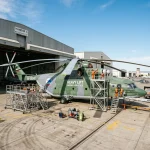
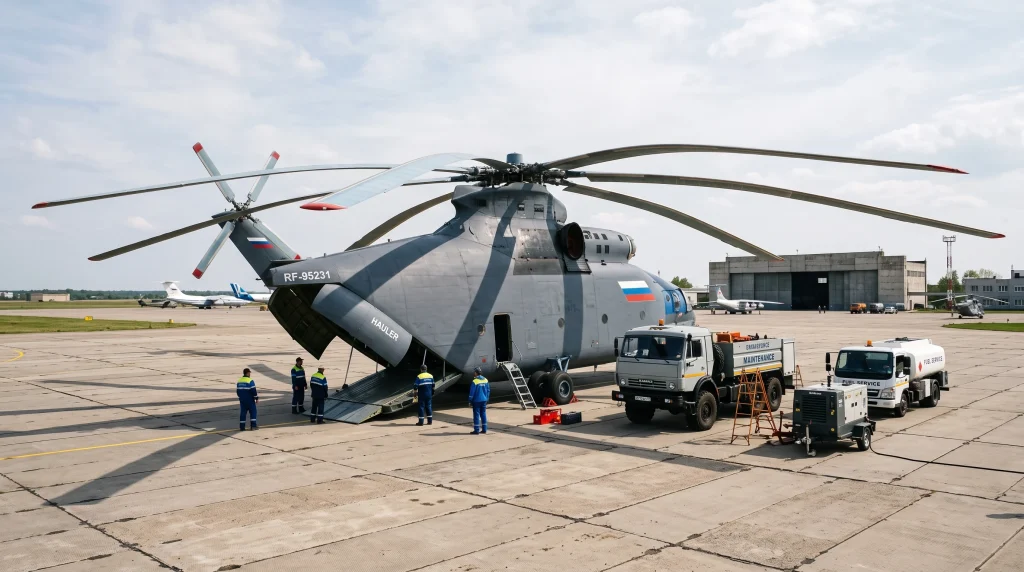
The biggest helicopter in the world in active military and commercial service is the Mil Mi-26 (NATO designation: Halo), a super-heavy transport helicopter engineered with a maximum takeoff weight of 56,000 kg (123,458 lbs) and an external sling lift capacity of 20,000 kg (44,092 lbs). Propelled by twin Lotarev D-136 turboshaft engines generating 22,800 total shaft horsepower through a titanium eight-blade main rotor spanning 32 meters (105 ft), the Mi-26 possesses a cargo hold equal in cubic volume to a Lockheed C-130 Hercules transport aircraft.
Super-heavy helicopters represent the pinnacle of rotary-wing mechanical power and aerodynamic engineering. Operating at gross weights that rival twin-engine regional jetliners, these rotary behemoths solve logistics challenges where fixed-wing aircraft cannot land and ground terrain is completely impassable. From lifting downed passenger aircraft and deploying massive prefabricated electrical transmission towers to airlifting 100 combat troops into remote mountains, understanding the world’s largest helicopters requires examining their drivetrains, disc loading physics, and structural limits.
Global Heavy-Lift Rotorcraft Ranked by Maximum Takeoff Weight (MTOW)
The following engineering benchmark table outlines the physical parameters, engine outputs, and maximum gross weights of the largest production and operational helicopters in aviation history.
| Helicopter Airframe | Country of Origin | Max Takeoff Weight (MTOW) | Max Useful Payload | Main Rotor Diameter | Installed Engine Horsepower |
|---|---|---|---|---|---|
| Mil Mi-26 Halo | Soviet Union / Russia | 56,000 kg (123,458 lbs) | 20,000 kg (44,092 lbs) | 32.0 m (105 ft 0 in) | 22,800 shp (2x D-136) |
| Mil Mi-6 Hook | Soviet Union | 42,500 kg (93,700 lbs) | 12,000 kg (26,455 lbs) | 35.0 m (114 ft 10 in) | 11,000 shp (2x Soloviev D-25V) |
| Sikorsky CH-53K King Stallion | United States | 39,916 kg (88,000 lbs) | 15,875 kg (35,000 lbs external) | 24.1 m (79 ft 0 in) | 22,500 shp (3x GE T408) |
| Sikorsky CH-53E Super Stallion | United States | 33,340 kg (73,500 lbs) | 14,515 kg (32,000 lbs external) | 24.1 m (79 ft 0 in) | 13,140 shp (3x GE T64) |
| Boeing CH-47F Chinook | United States | 22,680 kg (50,000 lbs) | 10,886 kg (24,000 lbs) | 18.29 m (x2) (60 ft 0 in) | 9,466 shp (2x Honeywell T55) |
| Sikorsky S-64 Aircrane / CH-54 | United States | 21,320 kg (47,000 lbs) | 9,072 kg (20,000 lbs external) | 21.95 m (72 ft 0 in) | 9,600 shp (2x Pratt & Whitney T73) |
Mechanical Architecture of the Mil Mi-26 Halo
Lifting a 56-metric-ton aircraft vertically without aerodynamic stall requires extraordinary transmission torque handling and structural rigidity. The engineering breakthroughs that allow the Mi-26 to remain the biggest helicopter in the world include:
The VR-26 Main Reduction Gearbox
The mechanical heart of the Mi-26 is the VR-26 transmission gearbox. Weighing 3,639 kg, the split-torque planetary gearbox reduces engine input shaft speeds from 8,300 RPM down to 132 RPM at the main rotor head, delivering over 19,700 kilonewton-meters of continuous mechanical torque. The design divides torque across dual gear paths, preventing single-point tooth shear under full engine throttle.
Titanium Hub and Composite Rotor Blades
The Mi-26’s eight main rotor blades span 32 meters in diameter, sweeping an area of 804.2 square meters. Each blade features a tubular titanium spar with aerodynamically contoured glass-fiber composite pocket fairings, equipped with electro-thermal anti-icing elements that allow operation in extreme Arctic blizzards down to -50°C.
Cargo Hold and Loading Capabilities
The pressurized cargo hold measures 12.0 meters in length, 3.2 meters in width, and 3.17 meters in height. Featuring an electrically operated overhead traveling gantry crane and twin floor-mounted winches, the Mi-26 loads two armored personnel carriers, modular construction trailers, or up to 90 combat troops through its hydraulically operated rear ramp and clam-shell doors.
Western Counterparts: CH-53K King Stallion & CH-47F Chinook
Western aerospace manufacturers approached heavy-lift rotorcraft engineering with different design priorities, optimizing for shipboard compatibility, high-altitude desert hovering, and digital automation:
- Sikorsky CH-53K King Stallion: Built for the US Marine Corps, the CH-53K delivers triple-engine redundancy (three GE T408 turboshafts producing 7,332 shp each). Incorporating modern fly-by-wire flight controls and elastomeric rotor bearings, the King Stallion lifts an external 27,000-pound armored JLTV vehicle over 110 nautical miles under high-hot conditions (103°F at 3,000 feet altitude).
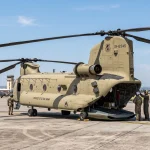
- Boeing CH-47 Chinook: Utilizing counter-rotating tandem rotors, the Chinook directs all engine output toward vertical lift by eliminating the anti-torque tail rotor. This makes the Chinook exceptionally capable in thin mountain air, serving as the frontline heavy transport for high-altitude operations in the Hindu Kush and Andes ranges.
Frequently Asked Questions About the Biggest Helicopter in the World
What is the biggest helicopter in the world?
The Mil Mi-26 Halo is the biggest operational helicopter in the world. It has a maximum takeoff weight of 56,000 kg (123,458 lbs), an eight-bladed main rotor spanning 32 meters, and a cargo capacity of 20 metric tons.
What was the heaviest helicopter ever constructed in history?
The heaviest helicopter ever built was the experimental Soviet Mil V-12 Homer (1968), which featured twin transverse rotor systems spanning 67 meters and had a maximum takeoff weight of 105,000 kg (231,485 lbs). It lifted a record-breaking 44,205 kg in 1969.
How many people can the biggest helicopter carry?
The Mil Mi-26 can transport up to 90 seated combat troops with full gear, or 60 stretcher patients with medical personnel during emergency disaster evacuations.
How do super-heavy helicopters compare to passenger tour helicopters?
Heavy transport helicopters are industrial cargo platforms designed for high payload logistics. For scenic coastal flights, operators choose nimble, quiet turbine aircraft with panoramic visibility. Learn more about rotorcraft performance in our guide on biggest helicopter on Earth dimensions and rotor spans.
Get our latest guides, news, and insights highlighted in your Google Search & AI Overviews.