✨ This article was AI edited. Editorial responsibility: HelicopterToursofSantaBarbara.com.
Produced with AI. This article was artificially generated. Editorial responsibility: HelicopterToursofSantaBarbara.com.
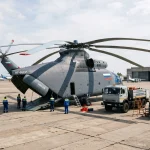
The history of the world’s biggest helicopter centers on daring Cold War aerospace engineering programs designed to push vertical flight physics to its theoretical limits. The pinnacle achievement in giant rotary-wing engineering was the Soviet Mil V-12 (NATO: Homer), an experimental transverse twin-rotor behemoth boasting a maximum takeoff weight of 105,000 kg (231,485 lbs) and powered by four Soloviev D-25VF turboshafts delivering 26,000 combined shaft horsepower. It remains the largest rotorcraft ever built and flown in human history.
During the 1950s, 1960s, and 1970s, military strategists and civil transport planners sought rotary-wing solutions capable of lifting entire ballistic missile batteries, radar complexes, and city-to-city commuter cabins without needing concrete airstrips. This era gave rise to radical aerodynamic configurations: tip-jet pressure burners, transverse wing-mounted dual rotors, compound gyrodynes, and monstrous skeletal flying cranes. While modern aviation prioritized efficiency and multi-role composite utility, these experimental titans established the absolute structural and aerodynamic thresholds of vertical lift.
Historical Timeline of Giant Experimental Rotorcraft
The drive to engineer the world’s biggest helicopter produced radical airframes that challenged conventional torque management, mechanical vibration mitigation, and blade dynamics.
| Aircraft Designation | Year of First Flight | Takeoff Weight (MTOW) | Drive System Concept | Rotor Arrangement | Historical Milestone |
|---|---|---|---|---|---|
| Hughes XH-17 Flying Crane | 1952 | 23,587 kg (52,000 lbs) | Tip-Jet Compressed Gas Burners | Single Two-Blade Rotor (130 ft dia) | Largest rotor diameter ever spun on a single hub |
| Fairey Rotodyne | 1957 | 17,237 kg (38,000 lbs) | Compound Gyrodyne with Tip-Jets | Four-Blade Rotor + Twin Turboprops | First vertical-takeoff commercial airliner concept |
| Mil Mi-6 Hook | 1957 | 42,500 kg (93,700 lbs) | Twin Turboshaft with Aux Wings | Five-Blade Main Rotor (35 m dia) | First mass-produced heavy-lift turbine helicopter |
| Mil V-12 (Mi-12) Homer | 1968 | 105,000 kg (231,485 lbs) | Transverse Gear-Linked Turboshafts | Twin Counter-Rotating 35 m Rotors | Unbroken world record for heaviest rotary-wing aircraft |
| Mil Mi-10 Harke | 1960 | 43,700 kg (96,340 lbs) | Twin Turboshaft Specialized Crane | High-Stilt Quad Under常用 Undercarriage | First dedicated containerized cargo flying crane |
The Colossus of Moscow: Engineering the Mil V-12 Homer
In the mid-1960s, the Soviet Strategic Rocket Forces confronted an insurmountable logistical challenge: deploying intercontinental ballistic missiles (ICBMs) such as the 8K67 (SS-9 Scarp) into secret silos scattered across the roadless, swampy Siberian taiga. Traditional railway lines were easily monitored by Western reconnaissance satellites. The solution was Project 65, which materialized as the Mil V-12.
Transverse Twin-Rotor Architecture
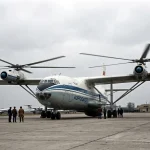
To lift a 30-ton missile container plus fueling trucks, Mikhail Mil’s design bureau determined that a single rotor system would require a blade span so immense that aeroelastic deflection and tip stall would tear the blades apart. Instead, the team placed two complete Mil Mi-6 rotor heads side by side on inverse-tapered transverse wings spanning 67 meters (220 feet) from tip to tip.
Each wingtip supported two Soloviev D-25VF turboshaft engines producing 6,500 shp each, driving a 35-meter five-bladed rotor. Crucially, a central cross-shaft mechanically connected both rotor systems through a mid-fuselage transmission. If an engine failed on one wingtip, the remaining engines distributed torque equally to both rotors, preventing asymmetric thrust rollover—a monumental mechanical engineering triumph.
The Unbroken 1969 World Records
On August 6, 1969, test pilot Vasily Koloshenko flew the V-12 to a certified FAI world record, lifting 44,205 kg (97,455 lbs) to an altitude of 2,255 meters. No rotary-wing aircraft before or since has ever matched this payload ceiling. When the V-12 made its international debut at the 1971 Paris Air Show at Le Bourget, Western aerospace analysts, including Sikorsky representatives, awarded Mikhail Mil the prestigious Sikorsky International Trophy for rotary flight innovation.
Hughes XH-17: The Tip-Jet Flying Crane
In 1952, Howard Hughes financed and constructed the Hughes XH-17, designed under contract for the US Air Force to lift heavy field artillery and bridge spans. The aircraft tackled the torque problem by eliminating mechanical transmission entirely.
Two Allison J35 turbojets bled compressed air through hollow titanium rotor spars out to combustion chambers mounted at the rotor blade tips. Fuel was injected and ignited at each tip, spinning the rotor without generating torque on the fuselage. While this eliminated the need for a tail rotor, the tip-jets created an ear-splitting noise profile audible for miles and exhibited an astronomical fuel burn rate that restricted operational endurance to just 40 nautical miles, leading to program cancellation in 1955.
Fairey Rotodyne: The Supersonic Tip-Jet Airliner That Almost Was
British aviation produced one of the most promising commercial rotorcraft concepts in the Fairey Rotodyne. Designed as a 48-seat city-center airliner, the Rotodyne took off vertically as a helicopter using rotor tip-jets. Once airborne, forward thrust was transferred to two wing-mounted Napier Eland turboprops, allowing the rotor to enter autorotation like an autogyro, reaching cruise speeds of 191 mph (307 km/h).
Despite successfully demonstrating airline-style city-center flights between London and Paris, the Rotodyne’s tip-jets created severe noise complaints in urban trials, and defense budget cuts terminated the project in 1962.
Why Modern Aviation Settled on the Mil Mi-26
As microelectronics and aerospace materials advanced, military forces abandoned ultra-giant single-purpose airframes like the V-12. The emergence of lighter solid-state avionics, mobile road-transportable missiles (like the RT-2PM Topol), and high-efficiency twin-turboshaft drivetrains led Mikhail Mil’s bureau to design the single-rotor Mil Mi-26. By achieving a 20-ton payload in a standard tail-rotor configuration, the Mi-26 delivered 85% of the V-12’s practical operational utility at one-third the maintenance overhead, establishing itself as the definitive world record holder in series production.
Frequently Asked Questions About Historic Giant Helicopters
What was the largest helicopter ever flown?
The Mil V-12 Homer is the largest helicopter ever flown in aviation history, with a maximum takeoff weight of 105,000 kg (231,485 lbs) and a wingspan of 67 meters across its twin transverse rotor systems.
Did the Mil V-12 ever enter mass production?
No, only two prototypes of the Mil V-12 were ever built. By the time flight testing concluded in the early 1970s, Soviet ballistic missile technology had shrunk in size, rendering the massive airframe redundant. One prototype resides at the Monino Central Air Force Museum in Moscow, and the second is preserved at Mil Moscow Helicopter Plant in Tomilino.
How did tip-jet helicopters work?
Tip-jet helicopters like the Hughes XH-17 pumped compressed air or hot exhaust gases from jet engines through hollow rotor blades out to small combustors located at the tips. Igniting fuel at the tips propelled the blades without transferring torque to the helicopter body, eliminating the tail rotor.
Are giant experimental helicopters safe compared to modern rotorcraft?
Early experimental giants suffered from intense vibration resonance and mechanical complexity. Modern helicopters rely on rigorous structural testing, redundancy, and health and usage monitoring systems (HUMS). For insights into rotorcraft safety mechanisms, review our research on helicopter accident causes and flight safety engineering.
Get our latest guides, news, and insights highlighted in your Google Search & AI Overviews.