✨ This article was AI edited. Editorial responsibility: HelicopterToursofSantaBarbara.com.
Produced with AI. This article was artificially generated. Editorial responsibility: HelicopterToursofSantaBarbara.com.
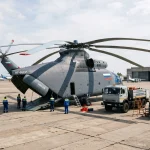
The world biggest helicopter currently in active production and operational service is the Mil Mi-26 (NATO reporting name: Halo), a heavy-lift rotorcraft engineered with a maximum takeoff weight of 56,000 kg (123,458 lbs) and an external or internal payload capacity of 20,000 kg (44,092 lbs). Driven by twin Lotarev D-136 turboshaft engines delivering a combined 22,800 shaft horsepower through an eight-bladed main rotor system, the Mi-26 outclasses all western and eastern rotorcraft in sheer volumetric cargo hold dimension and lift capacity.
Heavy-lift rotorcraft serve as critical logistical backbones across remote infrastructure engineering, military expeditionary logistics, specialized firefighting operations, and disaster recovery missions. When airfields are unavailable or natural disasters sever ground corridors, the world biggest helicopters deploy modular equipment, heavy construction machinery, and entire tactical formations directly into austere environments. Understanding the engineering, operational ceilings, and payload metrics of these mega-transports requires examining both operational machines and developmental heavy-lift architectures.
Top 5 World’s Biggest Operational Helicopters Ranked by Payload
Payload capacity remains the definitive aviation metric when ranking rotary-wing transports. Operating at extreme gross weights requires massive transmission gearing, high-solidity rotor heads, and immense engine torque reserves.
| Rotorcraft Model | Country / Manufacturer | Max Takeoff Weight (MTOW) | Max Payload Capacity | Main Rotor Diameter | Primary Mission Role |
|---|---|---|---|---|---|
| Mil Mi-26 Halo | Russia (Rostvertol) | 56,000 kg (123,458 lbs) | 20,000 kg (44,092 lbs) | 32.0 m (105 ft 0 in) | Strategic Heavy Cargo & Disaster Relief |
| Sikorsky CH-53K King Stallion | United States (Sikorsky/Lockheed) | 39,916 kg (88,000 lbs) | 15,875 kg (35,000 lbs external) | 24.1 m (79 ft 0 in) | Expeditionary Heavy-Lift Marine Logistics |
| Boeing CH-47F Chinook | United States (Boeing) | 22,680 kg (50,000 lbs) | 10,886 kg (24,000 lbs) | 18.29 m (60 ft 0 in) (x2) | Tandem-Rotor Tactical Battlefield Transport |
| Sikorsky CH-54 Tarhe / S-64 Aircrane | United States (Erickson) | 21,320 kg (47,000 lbs) | 9,072 kg (20,000 lbs) | 21.95 m (72 ft 0 in) | Skeletal Skycrane & Aerial Firefighting |
| Mil Mi-38 | Russia (Kazan Helicopters) | 15,600 kg (34,392 lbs) | 5,000 kg (11,023 lbs) | 21.1 m (69 ft 3 in) | Medium-Heavy Multi-Role Transport |
Engineering the Mil Mi-26: The Undisputed Heavy-Lift Giant
The development of the world biggest helicopter began in the 1970s under the designation V-26, tasked with replacing the aging Mil Mi-6 and Mi-10 hook transports. The Soviet design bureau required a machine capable of transporting combat vehicles, mobile radar complexes, and standard cargo containers weighing up to 20 metric tons directly into unimproved tundra and mountainous permafrost regions without runways.
Powerplant and Transmission Mechanics
Lifting 56 metric tons into a stable hover out of ground effect (HOGE) necessitates unprecedented mechanical output. The Mi-26 integrates two Lotarev D-136 turboshafts, each rated at 11,400 shaft horsepower (8,500 kW). Torque is channeled through the massive VR-26 main gearbox, capable of handling continuous power inputs exceeding 20,000 shp—making it the highest-torque mechanical transmission ever installed in an aircraft. The eight-bladed main rotor spans 32 meters, constructed from titanium spar structures with glass-fiber composite aerofoils to sustain immense cyclic bending moments.
Cargo Hold Dimensions and Loading Capabilities
The interior cargo compartment of the Mi-26 matches the volume of a four-engine Lockheed C-130 Hercules transport aircraft. Measuring 12 meters in length, 3.2 meters in width, and 3.17 meters in height, the hold accommodates up to 90 combat-ready troops, 60 stretcher patients with medical attendants, or two standard military utility trucks. Twin electric hoists riding an overhead rail system lift internal freight up to 5,000 kg, while the rear clam-shell doors and hydraulically actuated cargo ramp facilitate drive-on vehicle operations.
Western Heavy-Lift: The Sikorsky CH-53K King Stallion
While the Mi-26 holds absolute volumetric and weight records, the United States Marine Corps’ Sikorsky CH-53K King Stallion represents the apex of modern high-density composite engineering and digital flight control. Engineered specifically for maritime expeditionary logistics and harsh high/hot operating environments, the King Stallion delivers unprecedented power density within a footprint constrained by naval amphibious assault ship flight decks.
Fly-By-Wire and High/Hot Hovering Dynamics
Unlike earlier heavy-lift platforms that rely on mechanical linkages and hydraulic boost actuators, the CH-53K incorporates full digital fly-by-wire (FBW) flight controls with active sidestick controllers. The system automatically stabilizes the aircraft in brownout dust conditions, preventing pilot spatial disorientation during landing flares in desert combat zones. Powered by three General Electric T408-GE-400 turboshaft engines producing 7,332 shp each (over 22,000 total shp), the CH-53K can carry an external payload of 27,000 pounds (12,247 kg) over an unrefueled mission radius of 110 nautical miles at temperatures exceeding 33°C (91.5°F).
Tandem-Rotor Efficiency: The Boeing CH-47 Chinook Family
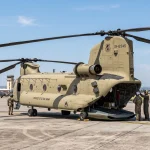
The tandem-rotor configuration pioneered by Vertol and perfected by Boeing in the CH-47 Chinook provides distinct aerodynamic advantages for medium-to-heavy tactical lift. By placing counter-rotating rotors at the front and rear of the fuselage, the Chinook eliminates the need for an anti-torque tail rotor, directing 100% of engine output toward vertical thrust.
The latest CH-47F Block II variant increases maximum gross weight to 54,000 pounds, incorporating redesigned composite rotor blades (ACRB) that generate an additional 1,500 pounds of lift per rotor head. The tandem geometry makes the Chinook uniquely stable in gusty mountain canyons and allows the aft ramp to touch down on rooftop edges or pinnacle mountain ledges while the forward rotor remains airborne.
Civilian Heavy-Lift and Skycrane Operations
In civilian engineering, heavy helicopters are utilized when crane access is physically impossible. The Erickson S-64 Aircrane—originally developed as the military Sikorsky CH-54 Tarhe—features a specialized skeletal fuselage devoid of a conventional passenger cabin. This design allows pilots to operate an aft-facing control station, maintaining direct visual contact with external sling loads.
- High-Voltage Transmission Towers: S-64 cranes erect pre-fabricated steel pylons on inaccessible ridgelines in minutes rather than weeks.
- Timber Harvesting: Heavy heli-logging retrieves harvested old-growth logs without cutting access roads across sensitive ecosystems.
- Aerial Firefighting: Equipped with a 2,650-gallon belly tank and a ram-air snorkel system, an Aircrane fills completely from shallow lakes in under 45 seconds, dropping high-volume retardant curtains on wildfires.
Frequently Asked Questions About the World Biggest Helicopters
What is currently the world biggest helicopter?
The world biggest operational helicopter is the Russian Mil Mi-26 Halo. It has a maximum takeoff weight of 56,000 kg (123,458 lbs), a main rotor diameter of 32 meters, and can lift 20,000 kg (44,092 lbs) of internal or slung cargo.
What is the heaviest helicopter ever built in history?
The heaviest helicopter ever constructed was the experimental Mil V-12 (Homer), designed in the Soviet Union during the late 1960s. It had a maximum takeoff weight of 105,000 kg (231,485 lbs) and set an official world record on August 6, 1969, lifting 44,205 kg (97,455 lbs) to an altitude of 2,255 meters.
What is the most powerful US military helicopter?
The Sikorsky CH-53K King Stallion is the most powerful and capable heavy-lift helicopter in the United States military inventory. Powered by three General Electric T408 turboshafts producing a combined 22,000 horsepower, it can carry an external payload of 35,000 pounds.
Why do heavy helicopters cost so much to operate?
Heavy helicopters require enormous quantities of aviation turbine fuel (the Mi-26 burns roughly 3,700 liters per hour) and undergo rigorous transmission overhaul cycles. For a detailed breakdown of rotorcraft operational costs, review our analysis on MD500 operating expenses and hourly maintenance.
Get our latest guides, news, and insights highlighted in your Google Search & AI Overviews.